
fixes · 01
Three letters, four companies: the morning SPX refused to be one thing
One Sunday morning I typed three letters into the terminal and got four
different companies. I was after the S&P 500 — SPX, obviously — and the
palette came back with the index, sure, but also SpaceX's Germany listing,
SpaceX on two more European venues, a British industrial called Spirax
Group that happens to own the same letters on the London exchange, and a
stack of unlisted corporate records. All of them answering, correctly, to
"SPX."
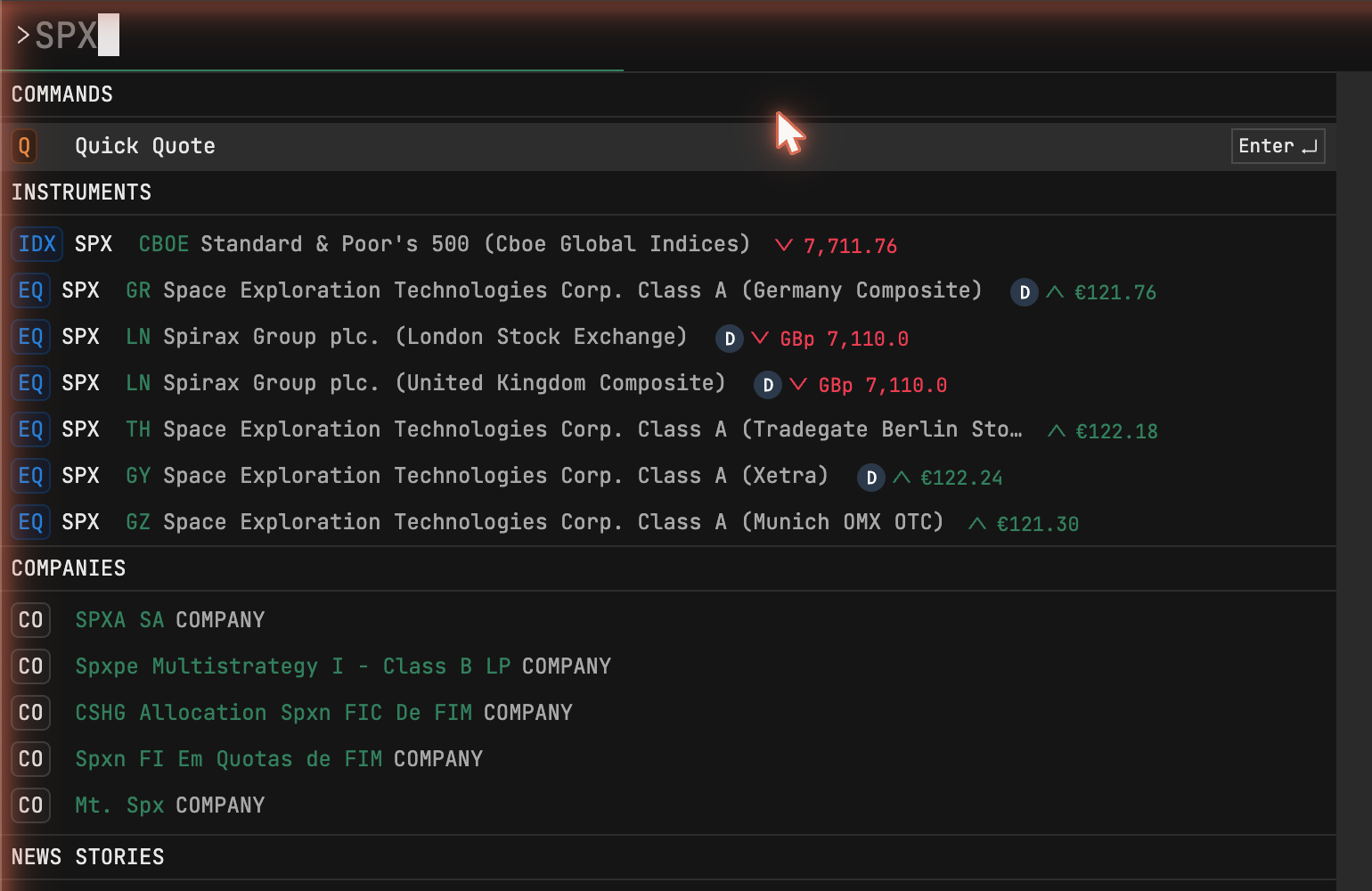
That screenshot is the fix for the most common frustration new operators report — "I typed the right ticker and got the wrong thing" — because it shows what a ticker really is here. Not an address. A search term. The palette isn't confused when it offers you five answers; it's being thorough about a world where the same letters legitimately belong to an index in Chicago, a rocket company's shares trading in Frankfurt, and a century-old engineering firm in London. Your job is one glance at the badges before Enter.
Reading the badges
The badges carry the whole system. IDX is an index. EQ is a listed
equity — and the small code after the symbol is the venue, so SpaceX's
Frankfurt line reads SPX GR while Spirax in London is SPX LN. CO is
a corporate record with no listing at all, which is how private companies
resolve. And a (D) on any row means that listing's data runs delayed,
a different clock entirely. Once you
read badges by reflex, the wrong-instrument problem simply stops existing:
the morning's SPX confusion resolves in the time it takes to see IDX on
the first row and press Enter on the thing you meant.
The same reading habit covers the two cousins of this problem. For US
stocks, the palette lists the same share once per venue — the row marked
US is the composite, the blended one you almost always want, and the rest
are plumbing for people who need a specific exchange. And for foreign names
generally, the venue suffix isn't decoration; it's how you tell the terminal
which listing's price, currency, and clock you're asking for. AZN LN is
AstraZeneca in London pounds, fifteen minutes back. Those five characters
are the whole answer.
Commands resolve too
One more resolution surprise worth meeting on purpose rather than by
accident: commands resolve through the same palette, and some take a ticker
in front while some stand alone. Type NVDA EQ AL expecting a Nvidia
alerts window and you'll get fuzzy matches instead, because
alerts is a bare command — just AL.
When a command "doesn't work," check whether it wanted to be naked. The
palette even surfaces people at funds in its search, which the first time
feels like a wrong answer and is really the same lesson as the whole page:
it's a search box over everything the terminal knows, and the badges tell
you which everything you're about to open.
If the right instrument opens and shows you nothing, that's the other story — blank windows — and between the two, they cover nearly every "it's broken" that turns out to be "it's telling you something."
Tickers on this page are teaching examples, not recommendations. TickerFluent publishes education, not investment advice.