
workflows · 08
Down 12% before lunch: the morning PayPal's $53 billion suitor walked away
Friday morning, August 28th, 2026. You own PayPal, or you're watching it, and somewhere between coffee and lunch it loses an eighth of its value. By the close it's at $53.73, down 12.59% on 36 million shares. If your information diet is a broker app, here's what you get: a red number, and — hours later — somebody's write-up. Now let me show you the same morning through the terminal, because this exact Friday is the fire-drill scenario the triage loop trains for, and running it for real beats any hypothetical I could invent.
The rule when a name is already down double digits: reverse the loop. Don't start with what the company is — start with what broke.
10:41 AM: the wire has the answer before your feed has a headline
PYPL EQ N. The stream is a wall of Friday noise — Fed Chair Warsh reviving
rate-hike bets, sector updates, weekend listicles — but scoped to one name
and sorted by time, the cause is sitting right there, from Reuters, stamped
10:41:57 AM:
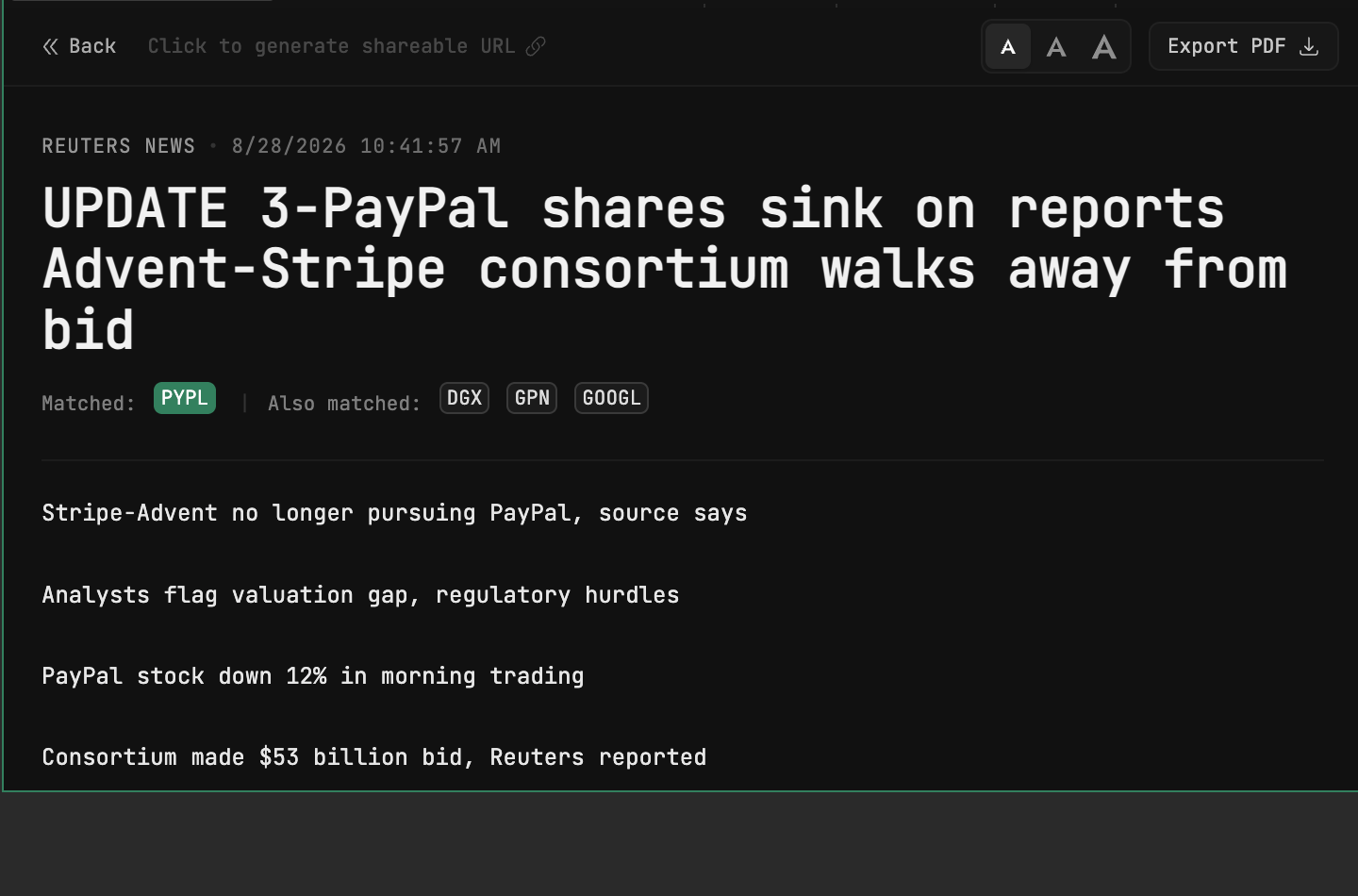
Read the deck under the headline, because it's the whole diagnosis in four lines. A consortium — Stripe and Advent — had made a $53 billion bid. A source says they're no longer pursuing it. Analysts flag the valuation gap and regulatory hurdles. The stock is down 12% on the news. This isn't a mystery move; it's a repricing with a timestamp. And note what the terminal did that your feed didn't: it separated the company-specific cause from the red-everywhere macro morning happening around it. The whole market fell after the Warsh headlines that day. PayPal fell for its own reason, and the wire told you which was which by 10:42.
The chart puts the morning in its year
PYPL EQ G, one year of dailies:
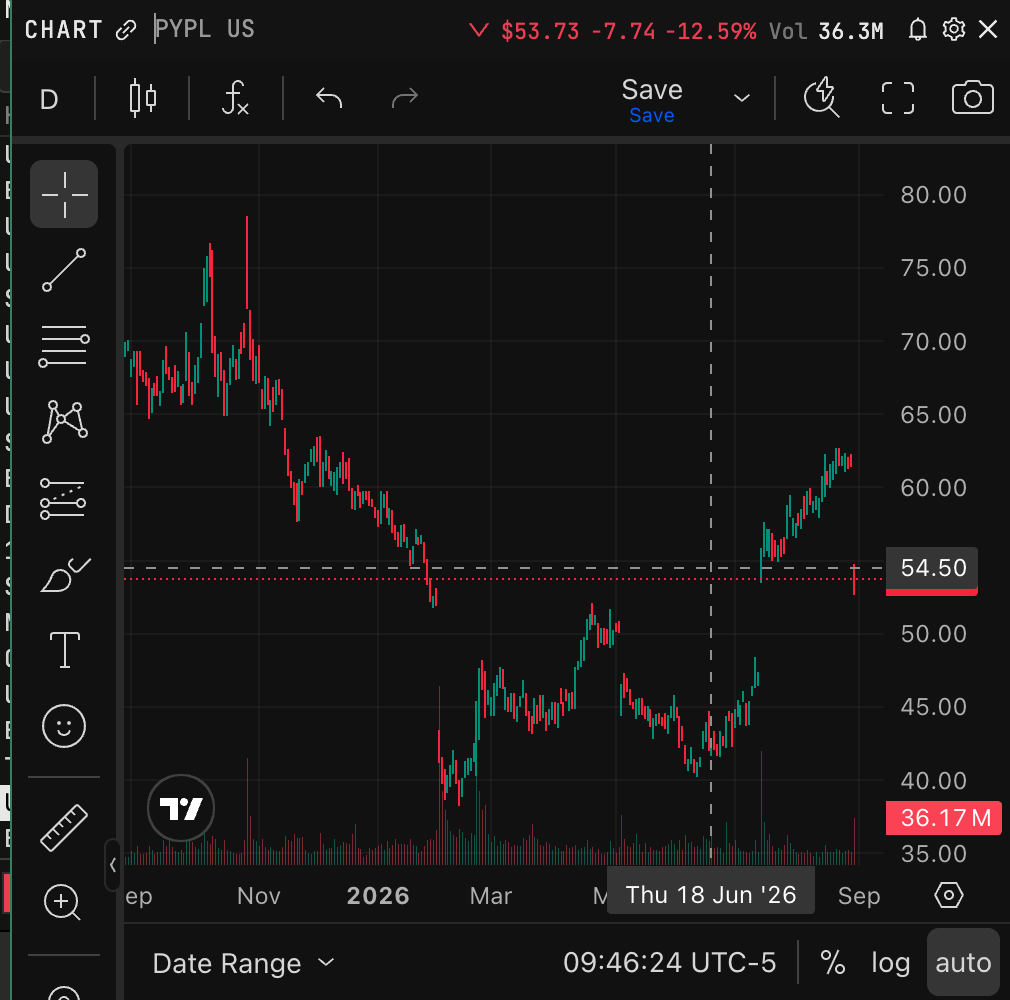
Look at the shape and Friday explains itself twice over. The stock had rallied hard into late summer — the period the bid reports were building — and Friday's cliff gives back a chunk of exactly that run. What died at 10:41 wasn't revenue or margins. It was a premium the market had been pricing in for weeks. The chart can't tell you that alone; the chart plus the headline can, and together they took about ninety seconds.
The question that sorts every deal-break
With the cause named, the loop's last diagnostic is the one that matters:
does the damage land on the reason you'd own the thing? A collapsed bid
is devastating to one kind of owner and nearly irrelevant to another. If the
thesis was "someone will pay a premium for this," that thesis died at
10:41:57 and the market spent the day marking it to zero. If the thesis was
the business itself — the statements, the cash flow, the segments — then
nothing in FA changed between Thursday and Friday, and what changed was
the price of admission. Same red number, two completely different Fridays,
and no one can run that sort for you. What the terminal does is hand you the
sorted facts while the move still matters — the wire even surfaced the
sub-plot that a famous fund's brand-new PayPal position was facing its first
test the same afternoon, which is the kind of color you otherwise get days
later in somebody's newsletter.
What this morning teaches
Three transferable moves, all runnable on the free tier. Scope the wire to the name and sort by time — the cause headline, if it exists, is minutes from the top. Read the deck under the headline before anyone's analysis of it. And place the move inside the year's shape before deciding what kind of move it is. That's the reverse loop: cause, context, thesis-check. Roughly three minutes, on a morning when three minutes was the difference between understanding the drop and just experiencing it.
The forward version — for names that hit your feed on excitement instead of fire — is the full triage loop, and the screen that makes sure you see the 10:41 headline at 10:42 is the watchlist wall.
Tickers on this page are teaching examples, not recommendations. TickerFluent publishes education, not investment advice.